
Organizing for Personality Types
This page may contain links to Amazon.com or other sites from which I may receive commission on purchases you make after clicking on such links. Read my full Disclosure Policy
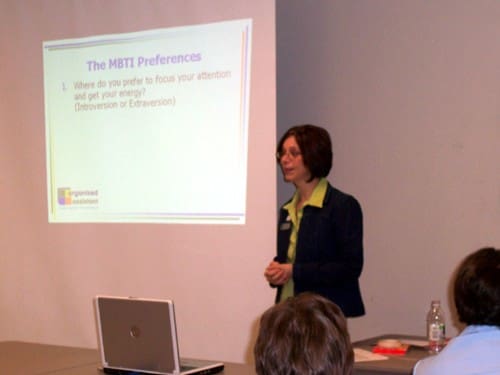
Do your organizing systems work well for some people, but not others?
One reason may be personality. We all approach time, space, routines, and decision-making differently, and understanding those differences can make it easier to create organizing systems that feel natural and sustainable.
One framework that can help us explore these differences is the Myers-Briggs Type Indicator® (MBTI®), a personality assessment designed to identify preferences in how people take in information, make decisions, and interact with the world.
While personality type doesn’t determine how organized someone is, it can influence organizing preferences and habits. That’s one of the reasons I became fascinated by the connection between personality type and organizing, and eventually developed organizing profiles for each of the 16 personality types.
What is the Myers-Briggs Type Indicator® and how does it work?
The Myers-Briggs Type Indicator®, or MBTI®, is a self-report questionnaire designed to help people determine their personality type. Here’s how it works.
Your responses to the assessment questions indicate your preferences in the following four areas:
- Direction of focus and source of energy
- Taking in information
- Making decisions
- Dealing with the outer world
Let’s look at each of those areas closely.
Direction of Focus and Source of Energy
People who prefer Extraversion direct their energy and attention outward. They receive energy from interacting with people and from taking action. People who prefer Introversion like to focus on their own inner world of ideas and experiences. They receive energy from reflecting on their thoughts.
If you prefer Extraversion, you are likely to:
- Act or speak before thinking
- Think best when talking to other people
- Take the initiative in making contact with other people
- Have broad friendships with many people
- Prefer spoken communication
- Tolerate noise and crowds
- Get restless without involvement with other people or activities
- Be equally at ease in a group or one-on-one
- Share personal information easily
- Become impatient and bored when your work is slow and unchanging
If you prefer Introversion, you are likely to:
- Think before acting or speaking
- Think best when alone
- Usually let other people initiate contact
- Have a few deep friendships
- Prefer written communication
- Avoid crowds and seek quiet
- Get agitated without enough alone time
- Prefer communicating one-on-one
- Share personal information only after trust has been established
- Become impatient and annoyed when your work is interrupted and rushed
Ways of Taking in Information
People who prefer Sensing like to take in information that is real and tangible – what is actually happening. They are observant about the specifics of what is going on around them and are especially tuned into practical realities. People who prefer Intuition like to take in information by seeing the big picture, focusing on the relationships and connections between facts. They want to grasp patterns and are especially tuned into seeing new possibilities.
If you prefer Sensing, you are likely to:
- Gather information through your senses: sight, sound, feel, taste and smell
- Look at specific details
- Deal with known facts
- Live in the present or past, enjoying what is or what was
- Learn step-by-step through observation and imitation
- Trust experience more than inspiration
- Prefer precise and exact information
- Appreciate and enjoy traditional and familiar ground
- Communicate by presenting the facts and details first
- See predictability as vital to your relationships
- Prefer to use existing skills rather than to take the time to learn new ones
If you prefer Intuition, you are likely to:
- Gather information by way of a “sixth sense” or a hunch
- Look at patterns and relationships
- Deal with possibilities
- Live in the future, anticipating what might be
- Learn by seeing connections and through general concepts
- Trust inspiration more than experience
- Prefer approximations and generalizations
- Appreciate and enjoy new and different experiences
- Communicate by presenting insights and ideas first
- See change as vital to your relationships
- Enjoy learning new skills for the challenge and novelty involved
Ways of Making Decisions
People who prefer Thinking like to look at the pros and cons of a situation and base their decisions on logical reasons and consequences. Their goal is to find a standard or principle that will apply in all similar situations. People who prefer Feeling like to base their decisions on personal values. Their goal is to create harmony and to treat each person as unique.
If you prefer Thinking, you are likely to:
- Decide with your head
- Base your decisions on logic
- Consider all the pros and cons
- Value fairness and reasonableness
- Analyze information
- Tend to question other people’s findings
- Notice ineffective reasoning
- Choose truthfulness over tactfulness
- Prefer brief and concise communication
- Show caring more impersonally
- Be task-oriented in the workplace
If you prefer Feeling, you are likely to:
- Decide with your heart
- Base your decisions on personal values – what you like or don’t like
- Consider the impact of your decisions on other people
- Value harmony and compassion
- Understand people
- Tend to agree with other people’s findings
- Notice when people need support
- Choose tactfulness over truthfulness
- Prefer social, friendly and even time-consuming communication
- Show caring through personalized words and actions
- Be relationship-oriented in the workplace
Ways of Dealing with the Outer World
People who prefer Judging like to live in a planned, orderly way, seeking to regulate and manage their lives. Sticking to a plan and schedule is important to them, and they are energized by getting things done. People who prefer Perceiving like to live in a flexible, spontaneous way, seeking to experience life rather than control it. Detailed plans and final decisions feel confining to them – they prefer to stay open to new information and last-minute options.
If you prefer Judging, you are likely to:
- Have a decisive, planned and orderly lifestyle
- Like a definite order and structure
- Prefer to reach conclusions
- Enjoy finishing things
- Desire to do the right thing
- Dislike surprises and last minute changes
- Work before play
- Respect and feel comfortable with traditional relationships
- Work best with a plan
- Like checking things off a “to do” list
If you prefer Perceiving, you are likely to:
- Have a flexible, adaptable and spontaneous lifestyle
- Like going with the flow
- Prefer to keep things open
- Enjoy starting things
- Desire to have many experiences
- Like surprises and last minute changes
- Seek opportunities to combine work and play
- Feel hemmed in and restricted by traditional relationships
- Work best when you can deal with issues as they come up
- Ignore your “to do” list, if you even make one
Your preferences in these four areas combine to form YOUR personality type! As there are 16 possible combinations, there are 16 personality types, each with its unique organizing profile.
My Work with Personality Type and Organizing
After completing the MBTI® Qualifying Program in 1999, I became fascinated by the relationship between personality type and organizing style. Over time, I gathered information through online surveys, workshop participants, individual clients, and extensive reading on personality type and organizing.
I used what I learned to create organizing profiles for each of the 16 personality types, highlighting common organizing strengths, challenges, and tendencies. These profiles reflect patterns I observed in my research and experience, not hard rules – every person is unique, and factors like lifestyle, habits, family responsibilities, work demands, and technology also influence how we organize.
You can check them out here:
While my organizing profiles were developed through MBTI training, research, surveys, and experience, personality-based organizing has evolved over the years. Today, there are many approaches that recognize an important truth: organizing is not one-size-fits-all.
Resources about Personality Type and Organizing
There’s no shortage of resources about personality type and organizing style!
In addition to my own surveys and experience, I incorporated information from some of the following books into my organizing profiles. If you’re eager to learn more about personality type and organizing style, I encourage you to add them to your reading list.
- Lifetypes, by Sandra Krebs Hirsh & Jean M. Kummerow
- Out of Time: How the Sixteen Types Manage Their Time and Work, by Larry Demarest
- Looking at Type in the Workplace, by Larry Demarest
- Type Talk: The 16 Personality Types That Determine How We Live, Love, and Work, by Otto Kroeger & Janet M. Thuesen
- Work Types, by Jean M. Kummerow, Nancy J. Barger & Linda K. Kirby
- Procrastination: Using Psychological Type Concepts to Help Students, by Judith A. Provost
- Type and Time Management, by Sharon Fitzsimmons
- Type Talk at Work: How the 16 Personality Types Determine Your Success on the Job, by Otto Kroeger, Janet M. Thuesen & Hile Rutledge
Since then, Productivity Leadership Coach Ellen Faye has published Productivity for How You’re Wired: Better Work. Better Life., a guide to help you develop strategies that work for you, which is based on the MBTI framework.
Want to talk about personality type – or anything else?
Join the POPS Circle, where organizing and productivity pros share ideas, experiences, and encouragement.
More Recent Thinking About Organizing Style
Although the organizing profiles on this site are based on Myers-Briggs personality type, newer books and frameworks explore the idea that organizing systems should be adapted to individual preferences, habits, energy, and ways of thinking. If you enjoy exploring why certain systems work for some people but not others, you may find these resources interesting.
- The Clutter Connection: How Your Personality Type Determines Why You Organize the Way You Do by Cassandra Aarssen describes organizing styles and habits, with a practical, non-one-size-fits-all approach.
- Organizing for Your Brain Type: Finding Your Own Solution to Managing Time, Paper, and Stuff by Lanna Nakone and Arlene Taylor suggests ways to adapt organizing methods to an individual’s cognitive preferences.
- Atomic Habits: An Easy & Proven Way to Build Good Habits & Break Bad Ones by James Clear is not not personality-based, but contains useful insights for understanding why systems stick (or don’t).
Learning about personality type and the way it influences our relationship with time and space was one of the reasons I decided to become a professional organizer in the first place, and I’m sure you’ll find it fascinating too.




16 Comments
Leave a Comment
The Productivity & Organizing Peer Support (POPS) Circle is a virtual community where organizing, productivity, and related professionals build genuine relationships, exchange ideas, and support one another’s growth.
Your first two meetings are free!
Thank you so much for creating lovely communities and introducing me to new people from all over the world.
Pam Holland, Mindful Decluttering and Organizing, LLC
This is always a fun group exercise, and I do believe the test results tend to be very accurate in helping us understand the way we process and interact with the world. I can’t quite remember what my result is, but now you’ve got me interested. I think I will go back and check!
I hope you can find it. It will be interesting when I post the organizing profiles, to see how well it reflects you.
I was just saying the other day that I hadn’t take this in years, since a team retreat in my corporate days in fact. I’ve become quite a mixture of both measures in each category! Nicely explained, Janet !
You must be all grown up now, Sue. 🙂 You probably still have your preferred modes of doing things, but you’re now able to adapt more easily than in your younger years.
Great post, Janet. I can see my personality in all of these types depending on the situation. However, in dealing with the outside world, I can see clearly that I am more of a “judging” type as opposed to “perceiving” type. Thanks for sharing. This was fun.
When I got involved with professional organizing, I assumed that all POs would be judging types. I quickly learned that I was wrong – that many have learned the hard way and now share what they learned with their clients.
Thanks for the concise explanations, Janet! It does help to understand ourselves and others. The different types aren’t better than others–just different. And that can be a very good thing!!
I love the way you express it – not better, just different! When I read I’m Not Crazy, I’m Just Not You in preparation for the MBTI training program, it was a real eye-opener. I highly recommend it!
It’s always so good to revisit this Janet. Thanks for the post…and the shout out. I feel like I see the world through an mbti filter. It explains why people are the way they are and why they do what they do. It’s not only helpful for our self understanding, but it’s always great to help us understand why others do what they do. I hope all your readers take a few minutes to discern their own type and then to read about themselves. It really does help us live better.
You explain it so well! Until I read I’m Not Crazy, I’m Just Not You by Roger Pearman, I thought people who acted differently than I would were deliberately being difficult or something. Realizing that we’re all wired differently was a real-opener and has helped me so many ways both professionally and personally.
These are great resources, Janet!
I’m an ESTJ, and while it doesn’t fit me perfectly, no matter when I take the test (and I’ve done it many times over the decades), I’m always an ESTJ. It gets it right that I procrastinate about doing things I don’t want to do at all.
I remember the olden days when you were a big MBTI person. I have to admit, while I can remember my own type, I’m no good at remembering and spotting the characteristics for other people without a list in front of me. (I feel the same way about DiSC and most other personality types. The main one that resonates with me is the one that Gretchen Rubin made up, the Four Tendencies, for which I’m a solid Obliger, fulfilling outer expectations and rejecting inner ones, especially with regard to organizing/time management thingies.)
I think the fact that you get the same results consistently shows how accurate the assessment is. I think the first time I was INTJ, but I really couldn’t relate to the descriptions I read. Every time since then, I’ve been ISTJ. That’s not to say my personality hasn’t evolved as I’ve matured, but my preferences haven’t changed much, if at all.
I love this detailed info about the personality types and relating them to organization. I have done this exercise twice with groups of people. I have fallen in the first two categories. INTJ and INSJ.
It is good to know the personalities of others so you can work with them in the best way.
You might enjoy The Art of Speedreading People: Harness the Power of Personality Type and Create What You Want in Business and in Life by Paul D. Tieger and Barbara Barron-Tieger.
Just Your Type: Create the Relationship You’ve Always Wanted Using the Secrets of Personality Type by the same authors is also good, but it’s about personal relationships.
I love learning more about myself and others, and the MBTI is one way to do that. I’ve taken the assesement at a few different points in my life and come up as an ENFJ. When I read the description, it seems to fit me very well. Although nothing is 100%. After all, we’re complex humans and are inconsistent.
Thank you as well for sharing the other resources. Another one I really like is the CliftonStrengthsFinder, which helps you identify your natural talents and focus on those strengths rather than weaknesses.
I believe we’re born with our personality type preferences, which means our MBTI results aren’t likely to change – even if our behaviors do, as we learn what others expect of us and adapting to circumstances as needed.